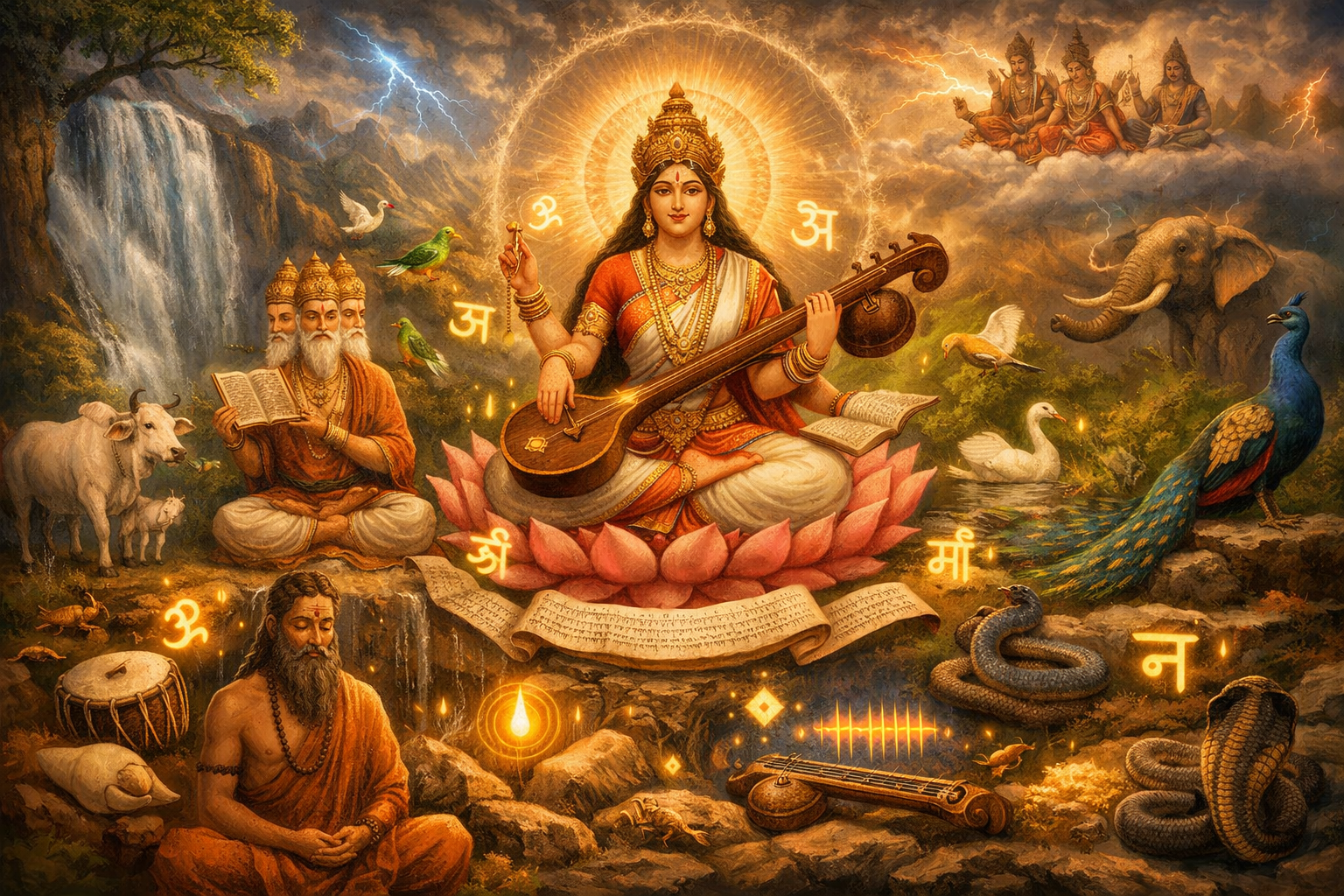
Lucknow: Speech or language, Vāk, has been venerated since early Vedic times as the creator of the world along with Brahma. Vāk was described as springing from the Creator, Brahma and also his consort, the twin Creative Principle. With language, a whole new world is created in our understanding. The sacred Vedas themselves are a manifestation of Vāk.
Speech has long been regarded as vital to understand consciousness which is considered one with the Supreme Being in many schools of Indian philosophy, making India remarkably advanced in the area of linguistics. The right word in the right place has always been considered to be of vital significance. Almost every section of the Vedas has an important reference to śabda-Brahman. The fact that four out of six Vedāńgas pertain to language show its importance in Indian tradition. The six Vedangas are Siksha (phonetics), Vyakarana (grammar), Nirukta (etymology), Chandas (prosody), Kalpa (rituals) and Jyotisha (astronomy).
Language in India has come down in an oral tradition; utmost importance was given to pronunciation, proper intonation and accent, more so in ritual chanting. Written language or script, was only a means to aid the reader recall the utterance and had no significance of its own. The life of language is in the breath of utterance. Nyaya Sastra says – वर्णानुमापकरेखोपरेखाविन्यासः लिपिः। That is, script is defined as a set of lines and curves that recall the syllables to us.
Vedic literature took all forms of life on earth as one organic system, recognising the same power of cognition and interaction with the environment in all species. Rgvedic mantras venerate Vāk as the goddess, as a prayer, as human speech, as sound of creatures such as cattle, frogs, birds, as sound of inanimate objects such as drums, etc., and as sounds of nature such as water, thunder etc.
“The gods created the Goddess Speech; the animals in all forms speak this (speech). May that speech (when) well praised come to us (as) sweet-sounding milch cow bestowing on us (lit. milking for us) refreshment and nourishment.” RV 8.100.11
यत्किञ्चेदम् प्राणिजङ्गमञ्च पतत्रि च वागेव आयतनम् आकाशः प्रतिष्ठा।
देवीं वाचमजनयन्त देवास्तां विश्वरूपाः पशवो वदन्ति।
सा नो मन्द्रेषां ऊर्जां दुहाना धेनुर्वागस्मान् उपसृष्ठुतैतत्।
Human beings are familiar only with a fourth of the whole range of Vak. Vedic references include the sounds of nature such as thunder and waterfalls, the call of birds, the language of animals and even that of the lowly worms and beetles within the range of the divine power of Vāk. It is stated that human speech uses only a fourth of the entire range of Vāk.

तदेतत् तुरीयम् वाचो निरुक्तम् यत् मनुष्या वदन्ति।
अथैतत् तुरीयम् वाचो निरुक्तम् यत् पशवो वदन्ति ॥
अथैतत् तुरीयम् वाचो न्रुक्तम् यत् वयांसि वदन्ति।
अथैतह् तुरीयम् वाचोऽनिरुक्तम् यदिदम् क्षुद्रसरीसृपाम् वदन्ति॥
In the higher levels of consciousness where speech originates, it is known as Parā Vāk, also called the śabdatattva, which Bhartrhari’s philosophy explains as the root cause of everything – the world and its understanding. In music, the pure vibration is known as Anāhata śabda and the manifest note that is uttered with specific pitch is called the Āhata śabda. Consciousness takes this path from a latent, undifferentiated level to a specific manifest level in the form of a particular word. The sole principle is Parā Vāk, which undergoes or adopts a seeming variety brought about by differentiation in varṇa, pada and vākya – i.e, phoneme, syllable, word and sentence.
Team Siddhanta Knowledge Foundation
https://siddhantaknowledge.org/